Article and blog
Czech grannies and Vietnamese grandchildren
A window into the childhood of the second generation of Vietnamese in Czechia
7 min
In short
- Many children of the second generation of Vietnamese in Czechia grew up with a Czech granny or auntie who looked after them while their parents worked.
- This creates two families – a Vietnamese one by blood and a Czech one of the heart – that complement rather than exclude each other.
- Czech grannies often guided children through the world of Czech traditions and could support their mothers too.
- The Czech–Vietnamese model of care turns the usual idea of nannies upside down: the carers are women from the majority, often motivated by the joy of caring for children.
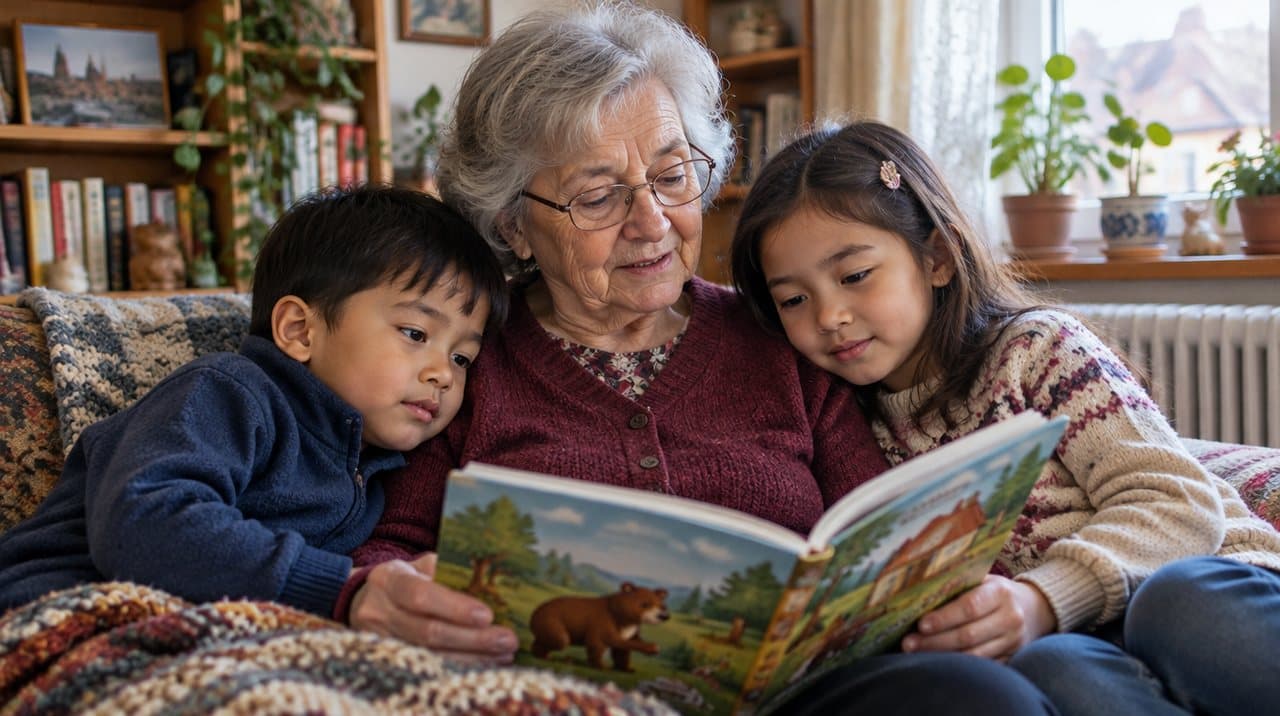
When I meet new people, we often end up talking about food. In those conversations I say that my favourite dish is my granny’s goulash, and then I add: “…my Czech granny’s.”
That sentence, however, does little to ease the confusion of the people I am talking to, and the conversation turns to my Czech family. This is not an unusual experience among the second generation of Vietnamese in Czechia; on the contrary, it is part of our everyday lives. Young Vietnamese grow up belonging to two families – a Vietnamese family by blood and a Czech family of the heart. The two do not exclude each other; together they create a unique model of care that overturns the usual idea of what a nanny is. The article opening before you, dear readers, is a window into the childhood of the second generation of Vietnamese. I dedicate it to all the grandchildren, grannies and aunties who made such unique family systems possible.
How the Nguyens found their granny
Most Vietnamese parents spend the overwhelming majority of their day at work. Childcare therefore moves outside the home – into the kitchens, living rooms and gardens of Czech grannies (Souralová, 2015a). Parenthood plays out in the labour market: the heavy time demands of running one’s own business lead to care being delegated to other people. This is reinforced by social and political norms in Vietnam, where parental leave is set at four to six months. It is customary for retired grandparents to look after the children so that people of working age can contribute to the family’s livelihood. The migration of the first generation, however, limited the possibility of relying on family networks to look after the children (Alber & Drotbohm, 2015). That is why Vietnamese parents turn to Czech grannies and Czech aunties. They are mostly women of retirement age, though that is not a rule. This is also where their two names come from – for some of us they are grannies, if they are older than our parents. For others they are aunties, if they are our parents’ age. In this article I mostly use the word grannies, but I mean both groups.
One of the main reasons for seeking out retired women is the belief that in retirement they have more time to look after children (Souralová, 2015b). Caring for Vietnamese children is a considerable time commitment, and Souralová (2020) describes two main models of childcare. In the first, the child lives with the granny and sees the parents on certain days of the week (at weekends, for example). In the second, the child stays with the granny during the day and returns to the parents in the evening after work. Both models, which are common in the Vietnamese community, make it clear that part of the upbringing rests on the shoulders of grannies and aunties. For the second generation of Vietnamese in Czechia, this part above all means growing into Czech culture. This, too, helped give rise to a generation that celebrates both Tết and Christmas. Although the whole Christmas tradition cannot be credited to grannies alone – other social factors such as school, peers and globalisation in general naturally play a role – for many of us it was the grannies who became our guides to the world of Czech traditions.
Grannies, mums and grandchildren
By guiding us through the world of Czech traditions, grannies shape key memories for the dual identity that resonates so strongly in young Vietnamese. When I interviewed young Vietnamese adults for my bachelor’s thesis, grannies and aunties were among the people they named most often as having helped them navigate their dual identity through unconditional acceptance (Kotlárová, 2025). A dual identity does not form only between two cultures. It also forms between two families. It is becoming common for young Vietnamese to see themselves as part of their Czech grannies’ and aunties’ families (Souralová, 2020). This relationship does not replace the one with their biological grandparents; instead, they are enriched by belonging to two family systems at once. The bond with non-biological grannies is built through time spent together. Time with grandparents in Vietnam, by contrast, tends to be shorter and more precious (Souralová, 2020).
Czech grannies also play another exceptional role. Thanks to this non-biological bond between Czech grannies and Vietnamese grandchildren, they become an anchor for young Vietnamese in the Czech environment. The memories both share form the basis of what the grandchildren consider “their Czech part”. Their role towards Vietnamese women should not be overlooked either. Many first-generation Vietnamese parents come to Czechia believing they will not stay for good. The goal is not life in Czechia but a return to their home country. For this reason, many members of the first generation see little benefit in learning Czech or building close relationships with members of the majority (Souralová, 2020). Czech grannies who welcome Vietnamese women’s children into their families can become guides to Czech culture for the mothers as well. They do not take the place of these women’s own mothers, but they can become an anchor for them too as they find their way in Czech society – for example when helping with homework, where many tasks rely on knowing Czech realities and customs (especially in the primary-school subjects about nature, society and the homeland).
The Czech–Vietnamese model of care
This relationship is not interesting only on a personal level. It also shows how the very idea of care is changing in Czechia. The usual model of nannies abroad involves women from the majority society, typically with a higher socioeconomic status, who hire migrant women to look after their children (Souralová, 2020). The Czech–Vietnamese model turns this idea completely upside down. Vietnamese women who migrated to Czechia see the core of their role as mothers in providing resources for their children, and so they look for nannies – even despite their potentially lower socioeconomic status (especially in the early stages of migration). The grannies and aunties, on the other hand, are women from the majority who, in retirement, did not have to depend on this income for their livelihood. Their motivation lay rather in the joy of caring for children (Souralová, 2015a).
Not every experience is the same
The experience I share with you is not universal for the entire second generation of Vietnamese in Czechia. Members of the second generation have probably met Czech aunties or grannies, but a non-biological family bond does not always form. In some cases, the main role of these carers is to pass on the Czech language to Vietnamese children rather than to provide long-term care. And a non-biological family bond may not form even when the care lasts for many years. None of this changes the fact that Czech grannies and aunties are an important phenomenon in Czech–Vietnamese relations.
Building such relationships means that today we can eat goulash and phở with the same love – a love that leaves the taste of childhood memories on our tongue. Not because we had to choose between two worlds, but because we have learned to live in both at once.
Quiz: did you get the article?
Pick an answer – you will see at once whether it is right, and why.
1. Why did Vietnamese parents often entrust everyday childcare to Czech grannies and aunties?
2. Which two models of childcare does Souralová (2020) describe?
3. How does the Czech–Vietnamese model of care differ from the usual nanny model abroad?
4. According to the interviews in Kotlárová’s bachelor thesis (2025), what role did Czech grannies and aunties play?
5. Does the experience with a Czech granny apply to the whole second generation of Vietnamese in Czechia?
Questions to reflect on
You can answer the questions anonymously. Answers appear once the TAMly team has checked them.
Who was your guide to the Czech world when you were a child?
Which food, holiday or custom still carries a memory of someone who looked after you?
Is there someone you would like to thank, years later? How might you do it?
Sharing guidelines
- Anonymously – no names or personal details.
- With respect – no insults, hate or attacks on others.
- Speak for yourself – your own experience and views.
- We protect privacy – do not share sensitive details about other people.
Sources and further reading
- Alber, E., & Drotbohm, H. (Eds.). (2015). Anthropological perspectives on care: Work, kinship, and the life-course (1st ed.). Palgrave Macmillan.
- Kotlárová, P. (2025). Přirozený mentoring u mladých dospělých vietnamského původu žijících v ČR [Bakalářská práce, Univerzita Karlova]. Digitální repozitář UK.
- Souralová, A. (2015a). New Perspectives on Mutual Dependency in Care-Giving. Ashgate Publishing.
- Souralová, A. (2015b). „That’s the Lady I Call Grandma!“: Vietnamese Children, Czech Grandmothers and the Meaning of Grandparenthood in the Biographies of Both. Czech Sociological Review, 51(5), 815–844. doi.org ↗
- Souralová, A. (2020). Grandparents, kinship ties, and belonging after migration: The perspective of second-generation grandchildren. Global Networks, 20(2), 362–379. doi.org ↗
How did you like this content?
★ 5.0 of 5 · 6 ratings
Read next

Bao Quyen: How do you build a heart? On the exhibition The Ceramic Heart
Bao Nhi, Bao Quyen „Niky“
The pilot episode of the podcast Příběhy mezi kulturami (Stories between cultures). Illustrator Bao Quyen “Niky” talks about the exhibition and comic The Ceramic Heart, about self-love, self-worth, pressure about appearance and the deep marks other people’s words can leave in us.
How will the new generation of Czech Vietnamese raise their children?
What do we want to keep from the way our parents raised us, and what would we change? We are preparing a study on parenting in the second generation of Vietnamese in Czechia.

Vietnamese people in the Czech Republic: migration, family and two cultures
Dan Le, Mgr. Jiří Kocourek
Sociologist and Vietnamese studies specialist Jiří Kocourek on the history and present of the Vietnamese minority in Czechia, relations between generations and life between two cultures.