Article and blog
The Ceramic Heart: self-love, comparison and silence in the Vietnamese community
Why we don’t have to hide our cracks
15 min · Published 24 October 2026

In short
- Criticism, comparison and remarks about the body in Vietnamese families rarely come from malice. They grow out of a culture of face, the Confucian idea that strictness is love, and a collective sense of self.
- When care becomes a condition for love, children carry away a fragile, contingent self-worth – it holds until it falls, like ceramics.
- A culture of silence keeps the pain unspoken: criticism breeds shame, shame breeds silence, and silence stops the criticism from ever being named.
- Self-compassion is not a Western import. Vietnamese culture already knows the Buddhist compassion từ bi – it only has to be turned towards oneself as well.
“You’ve put on a bit of weight.” “Why can’t you be like Mrs X’s daughter?” “Don’t tell anyone, it isn’t proper.” Three sentences nearly every Vietnamese child knows. And many of us still carry them at thirty.
A heart made of ceramics
Ceramics are solid until they fall. Then they break into pieces and we usually throw the shards away. The Japanese technique of kintsugi does the opposite: it mends the cracks with gold, so the repaired bowl is visibly different, but no less precious.
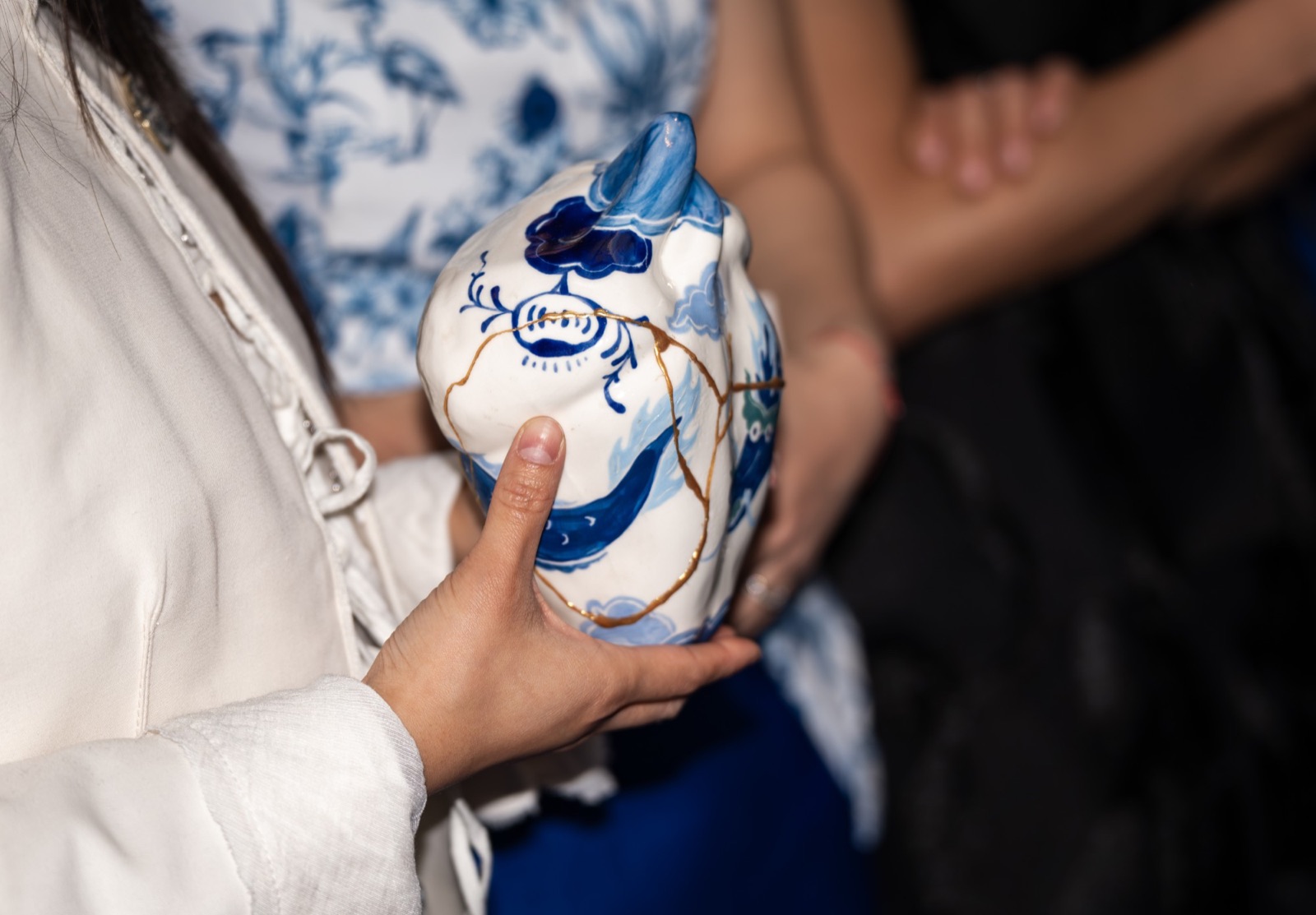
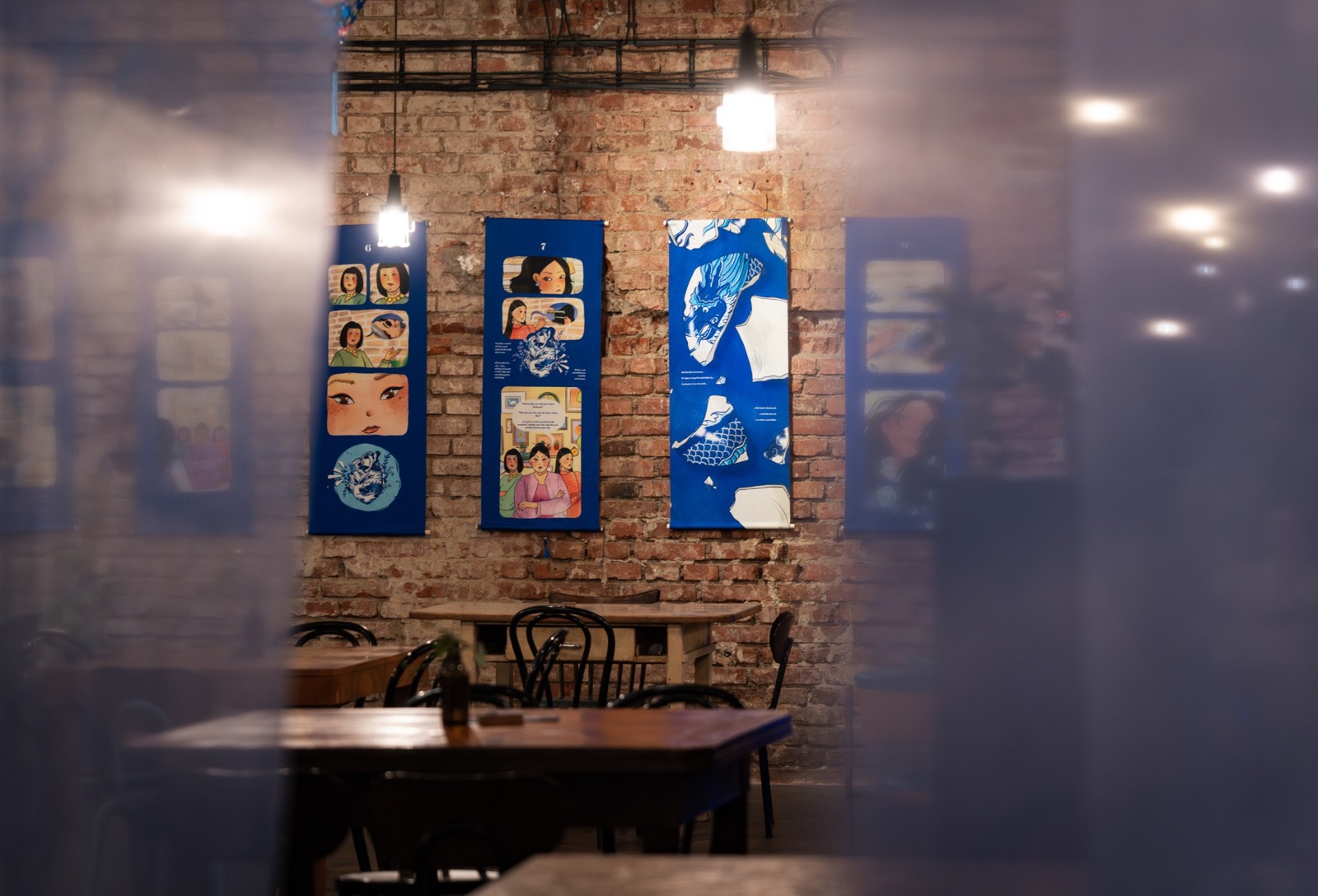
It is kintsugi that illustrator and comic author Bao Quyen “Niky” chose as the symbol of her project The Ceramic Heart. The comic and exhibition, made together with product designer and ceramicist Veronika Le, were on show at Vnitroblock in Prague from 2 April to 6 May 2026. They open up the experience of Vietnamese girls with remarks about their looks, with pressure to have the “right” body, and with why such words hurt more than people admit.
For the author it is a personal subject. In the TAMly podcast she recalls being told as a child that she “looked like an advert for famine”, that she was “terribly skinny” or that she looked “like a praying mantis”:
“It’s strange that someone says it out loud like that and doesn’t realise it can do something to a person psychologically, that you won’t forget it.” — Bao Quyen “Niky”, podcast Příběhy mezi kulturami

This text follows on from the exhibition. We ask why criticism, comparison and remarks about the body are so common in Vietnamese families and communities, what they do to our self-worth and why it is so hard to talk about. It draws on three fields: Vietnamese studies, which explain the cultural roots; psychology, which describes the effect on individuals; and sociology, which shows how patterns pass between generations and through migration.
It is not an indictment of parents or of culture. It is about understanding where the cracks come from, so that we can mend them with gold rather than cover them up.
Where the cracks begin: face, family and “we”
To understand why a Vietnamese auntie says “you’ve got fat” without a second thought, we have to start with three cultural pillars. They are not stereotypes but values that Vietnamese studies and cultural psychology have long described.
- Face (thể diện, sĩ diện). In Vietnamese society face is a kind of social currency. It has two layers: personal honour and a collective honour that belongs to the whole family or community (Vietnam Tourism). When a child fails, it is not only the child who loses face but the parents too. Hence expressions such as mất mặt (to lose face) and giữ thể diện (to keep face).
- The Confucian family and filial piety (hiếu). The family is hierarchical: elders have the right to advise, rebuke and judge, younger members the duty to obey and gratefully accept. The proverb Thương cho roi cho vọt, ghét cho ngọt cho bùi (“spare the rod for those you love, give sweets to those you dislike”) sums up a logic in which strictness is proof of love. Criticism is therefore seen not as an attack but as care.
- A collective self (“we” rather than “I”). Psychology speaks of an interdependent self-construal: people define themselves through relationships and roles (daughter, eldest son, daughter-in-law) rather than individual traits (Van Mai & Van Le, 2023). Remarks about someone else’s body are therefore not “interfering in private matters”. The body, achievements, marriage and children are to some extent the family’s shared property.
These values have a beautiful side too: cohesion, self-sacrifice and the sense of never being alone. According to a UNICEF study, feeling connected to one’s family is one of the main protective factors for the mental health of Vietnamese children (UNICEF Viet Nam, 2018). The problem starts when care becomes a yardstick, and the yardstick a condition for love.
“Con nhà người ta”
Vietnamese has its own name for it: con nhà người ta, literally “a child from someone else’s family”. She is the cousin who gets top marks, plays the piano, is slim and helps her parents. Nobody has ever seen all of her, but everybody knows she is better than you.
The Vietnamese daily VnExpress describes the phenomenon as a pressure that experts link to rising depression among teenagers. One expert it quotes calls parental expectations an “invisible pressure”, áp lực vô hình (VnExpress, 2022). A UNICEF study (2018) shows that comparison with peers is precisely what makes Vietnamese children’s school stress worse, and that in extreme cases frequent scolding over grades can even lead to suicide attempts (UNICEF Viet Nam, 2018, pp. 14–15).
What happens in the mind
As early as 1954 the psychologist Leon Festinger described how people naturally evaluate themselves by comparison with others, above all with their peers (social comparison theory). “Upward” comparison (with someone doing “better” than us) can motivate when we can find similarities between ourselves and the other person and so come to believe the goal is within reach.
But when someone is told again and again that they are fundamentally different from others and keep failing to reach the ideal set for them, a deep sense of inadequacy takes root.
Jennifer Crocker and Connie Wolfe have a precise term for this: contingent self-worth (Crocker & Wolfe, 2001). It is self-worth that depends on whether a person currently meets a particular standard, such as grades, weight or parental approval. Such self-worth is as fragile as ceramics: it holds until it falls. Every failure then sounds not like “I made a mistake” but like “I’m not good enough”.
“True love is strictness”? The data say otherwise
The public debate about Asian parenting was sparked by Amy Chua’s book about the “tiger mother”. Psychologist Su Yeong Kim then followed 444 Chinese-American families for eight years. The best outcomes, including the highest grade average, belonged to children of supportive parents. Children of “tiger” parents, by contrast, reported more depressive symptoms, more pressure and more alienation from their parents (APA Monitor, 2013). The study concerned Chinese rather than Vietnamese families, but the Confucian roots of their parenting are very close.
The message is not “love your child less demandingly”. It is: high expectations work when the child is also valued for who they are.
“Béo thế!”: when a remark about the body is a greeting
In Czech people greet each other with “hi, how are you?”. At a Vietnamese family gathering or at Tết you are more likely to hear Dạo này béo thế! (“You’ve put on weight!”), Sao đen thế? (“Why are you so dark?”) or Gầy quá, ăn đi! (“You’re too thin, eat!”). For the speaker it is a polite show of interest. For the person addressed, especially a teenage girl, it is a public verdict on her body.
Vietnamese has its own term for body shaming, miệt thị ngoại hình (mocking someone’s appearance), and Vietnamese media discuss it more and more. In 2023 the daily Tuổi Trẻ described how mocking people’s looks spreads on social media and is often brushed off as “just a joke”. One woman deleted her photos after comments about her weight and skin and withdrew even from her relatives (Tuổi Trẻ News, 2023). In a reader’s view for VnExpress, the author describes remarks about weight coming from friends, colleagues and family alike, and in both directions: at fat and thin people (VnExpress International, 2021).
An impossible ideal
The Vietnamese ideal of female beauty is narrow: slim but not “skinny”, fair skin, a small face, no spots. Fair skin has old class roots: dark skin meant working in the fields, fair skin a life that did not have to. Today the ideal is reinforced by adverts for whitening cosmetics, K-pop and social media filters. The result is that almost every body has some “flaw” that can be commented on.
Yet Vietnamese history offers a completely different model. Bao Quyen brought into the comic the figure of Bà Triệu, the legendary leader of a 3rd-century uprising against Chinese rule, after whom streets in Hanoi and elsewhere are named today. According to tradition she was no “beauty” by today’s standards: she was tall, strong, darker and untamed. She is credited with the famous line that she would rather ride the storm and slay the whale in the Eastern Sea than bow down and become someone’s concubine. The ideal of the “obedient, fragile and fair” girl is therefore not the only Vietnamese ideal.
The data are telling too. A cohort study of 353 schoolchildren in the city of Huế found that about half of them perceive their weight inaccurately, and that girls overestimate their weight more often than boys (10.8 % versus 8.0 %). Those who saw themselves as heavier than they were had roughly three times the odds of actually becoming overweight three years later (Tran et al., 2025). A negative body image does not protect health. If anything, it harms it.
Why it hurts so much
The objectification theory of Barbara Fredrickson and Tomi-Ann Roberts explains what happens when a girl is repeatedly judged by her looks: she starts to see herself through an observer’s eyes (Fredrickson & Roberts, 1997). This “watching oneself” is called self-objectification, and research links it to body shame, anxiety, eating disorders and depression.
In the Vietnamese context there is one more layer. The remark does not come from a stranger on the internet but from a grandmother, a mother or an auntie – people whose love matters most to the child. And out of filial piety, you do not talk back. That is why we remember “innocent” sentences longer than insults from strangers. Bao Quyen’s comic aims right at this. Its heroine, inspired by the author and by “every Vietnamese girl”, meets three aunties who start criticising her appearance. “Each of us has an auntie in the family who comes, says something and leaves,” the author says. “And you think about it for at least the next ten years.” At the same time she does not point only at others. She admits she grew up in a toxic environment and sometimes made remarks about other people’s looks herself. The comic therefore invites both sides to reflect: the one who hurts and the one who is hurt.
“Tốt đẹp phô ra, xấu xa đậy lại”: a culture of hiding
A Vietnamese proverb says: Tốt đẹp phô ra, xấu xa đậy lại – show what is beautiful, cover what is ugly. Two more add to it: Đóng cửa bảo nhau (problems are solved behind closed doors) and Vạch áo cho người xem lưng (“lifting your shirt so others can see your back”, that is, shaming yourself by revealing the family’s weaknesses). Silence here is not weakness but protection of the whole family’s face.
This has a direct effect on mental health. The 2018 UNICEF study found that Vietnamese children often confide their feelings in nobody, mainly so as not to worry their parents. Emotional isolation was among the most serious risk factors for suicidal thoughts. Parents often do not recognise their children’s difficulties or do not know where to look for help, and the stigma of mental illness keeps people from professional support (UNICEF Viet Nam, 2018, pp. 12–20). A meta-analysis of interventions in Asian communities names precisely “high levels of shame and criticism” as a barrier to seeking help (Kariyawasam et al., 2023).
So a vicious circle forms: criticism breeds shame, shame breeds silence, and silence stops the criticism from ever being named.
The second generation in Czechia: between two mirrors
Vietnamese people have been an official national minority in Czechia since July 2013, and the community estimates itself at about 100,000 people (Echo24/ČTK, 2017). Ethnologist Stanislav Brouček speaks of “visible and invisible Vietnamese”. That fits our subject too: outwardly a successful “model minority”, inwardly often an invisible pain.
Many children of the so-called 1.5 and second generation grew up with a Czech nanny and feel more Czech than Vietnamese. Their parents sometimes say they are mất gốc, “have lost their roots”, and they call themselves “banana children”, yellow outside and white inside. Sociologists Marta Lopatková and Lenka Formánková, analysing the Facebook group Confessions of the Vietnamese, showed that online anonymity is one of the few places where young Vietnamese can openly share intergenerational tension (Lopatková & Formánková, Český lid, 2022).
The second generation thus faces a double mirror. At home they hear Vietnamese standards (slimness, fair skin, obedience, top marks), at school a Czech racial lens and stereotypes. And there is often no shared language for feelings: the child can say “je mi úzko” (I feel anxious) in Czech, the parent understands the Vietnamese buồn better, but neither knows how to say the word so the other can hear it.
The host of the TAMly podcast adds an important observation: people in Vietnam have a kind of learned filter for such remarks and don’t take them to heart so much. Vietnamese people born in Czechia often lack that filter. They hear the same sentences as their peers in Hanoi, but they grew up in a culture where other people’s looks are not discussed out loud, so it hits them much harder. Bao Quyen first showed the exhibition in Hanoi, and the story seems to resonate there as well. Her cousin’s daughter, who lives in Vietnam, wrote to her after the visit that she completely found herself in the comic.
Self-love is not a Western import
Many Vietnamese parents hear the word “self-love” and think of selfishness or laziness. Psychology means something else. Kristin Neff defines self-compassion as three abilities (Neff, 2003):
- Kindness to oneself instead of harsh self-judgement.
- Common humanity: knowing that making mistakes and suffering are part of human life, not proof that I am different and worse.
- Mindfulness: seeing pain as it is, without exaggerating or suppressing it.
That is not “I think I’m the best”. It is “I don’t have to be the best to deserve love”. The difference from contingent self-worth is fundamental: worth here is not a reward for performance but the starting point.
Buddhism and Confucius in one soul
The most interesting finding for the Vietnamese experience comes from a 2008 comparative study by Neff, Pisitsungkagarn and Hsieh. They measured the highest self-compassion in Buddhist Thailand and the lowest in Taiwan, where the Confucian ideal of self-improvement through self-criticism is strong. The USA was in between (Neff et al., 2008). Later research concludes that self-compassion is partly shaped by culture, and that cultures built on self-criticism and shaming have less of it (Montero-Marín et al., 2018).
Vietnam stands exactly at the crossroads of these two traditions. Confucian family ethics live alongside the Buddhist idea of từ bi (compassion and kindness), which almost every grandmother who goes to the pagoda knows. Self-love is therefore not something young Vietnamese have to borrow from the West. It is a compassion Vietnamese culture already knows; we only turn it towards ourselves as well.
Does it work?
Yes. A meta-analysis of eight randomised trials with 1,012 participants from Thailand, Japan, China and Hong Kong found that self-compassion training significantly increases it in Asian communities (d = 0.56) and reduces stress. The authors also note that the set of studies is small and mostly involves students (Kariyawasam et al., 2023).
Kintsugi in practice
Bao Quyen explains why she chose kintsugi:
“What has been broken once doesn’t have to stay broken forever. We can mend it, but not so that it returns to its original shape. The wound will still be there; we just shape it so that it becomes part of our story.”
That is exactly what psychology calls mindfulness. Pain is neither erased nor replayed, but accepted as part of the journey. “Trying to forget something just doesn’t work,” the author adds.

For young people:
- Name the sentence. Try writing down the remark about your looks that you remember longest. Then write what you would answer today. This is exactly what the reflection questions of the TAMly podcast invite you to do.
- Separate intention from impact. Your auntie may have meant well, and it still hurt. Both are true at once.
- Talk to yourself as you would to a friend. If someone said to your best friend what you tell yourself in front of the mirror, would you let it go?
- Look for a safe place. Communities such as TAMly, peers with the same experience, or a professional.
For parents and the older generation:
- Greet differently. Instead of “you’ve put on weight”, try Dạo này con thế nào? (“How are you doing these days?”). It is just as Vietnamese and much safer.
- Praise effort, not the body or the result. Replace comparison with con nhà người ta by comparing your child with themselves a year ago.
- A child’s silence does not mean they are fine. According to UNICEF, children often keep quiet precisely to protect you.
Gold in the cracks
Criticism, comparison and remarks about the body in Vietnamese families rarely come from malice. They grow out of a culture of face, the Confucian idea that strictness is love, and a collective sense of self. But psychological research shows that when care becomes a condition, children carry away a fragile, contingent self-worth. And the culture of silence means nobody talks about it.
The Ceramic Heart offers a different story. Cracks are not a reason to hide. They are places where gold can appear: named pain, a conversation between generations, kindness to oneself. Accepting yourself is not a betrayal of family or culture. On the contrary, it can be a way of taking the best from it – cohesion and compassion – and leaving behind what hurts.
This text informs and shares experience; it does not replace professional help. If you are struggling, you can call Linka bezpečí on 116 111 or find help at nevypustdusi.cz.
Quiz: did you get the article?
Pick an answer – you will see at once whether it is right, and why.
1. What does the Vietnamese expression con nhà người ta mean?
2. According to Crocker and Wolfe, what is “contingent self-worth”?
3. In which country did the study by Neff et al. (2008) measure the lowest self-compassion?
4. According to the UNICEF study, why do Vietnamese children often confide their feelings in nobody?
5. What does kintsugi symbolise in the comic The Ceramic Heart?
Questions to reflect on
You can answer the questions anonymously. Answers appear once the TAMly team has checked them.
Which words about your looks or character do you still remember today?
How would you answer them today?
What would it mean for you to see your cracks as part of yourself?
Sharing guidelines
- Anonymously – no names or personal details.
- With respect – no insults, hate or attacks on others.
- Speak for yourself – your own experience and views.
- We protect privacy – do not share sensitive details about other people.
Sources and further reading
- TAMly (2026). Podcast Bao Quyen – The Ceramic Heart. Pilotní díl podcastu Příběhy mezi kulturami; citace podle přepisu, mírně jazykově upraveny. tamly.cz ↗
- Lopatková, M., & Formánková, L. (2022). „Confessions of the Vietnamese“: Young 1.5 and Second Generation Vietnamese Migrants in Online Space. Český lid, 109(1). ceskylid.avcr.cz ↗
- Echo24/ČTK (2017). Vietnamská komunita je stále uzavřená. Narušit to má až druhá generace (rozhovor se Stanislavem Broučkem). www.echo24.cz ↗
- UNICEF Viet Nam, ODI & Institute for Family and Gender Studies (2018). Mental health and psychosocial wellbeing among children and young people in Viet Nam. www.unicef.org ↗
- VnExpress (2022). Áp lực „con nhà người ta“. vnexpress.net ↗
- VnExpress International (2021). Vietnamese love to body shame. e.vnexpress.net ↗
- Tuổi Trẻ News (2023). Body shaming spreads on social media in Vietnam. news.tuoitre.vn ↗
- Vietnam Tourism. The concept of face in Vietnam. www.vietnamtourism.com ↗
- Crocker, J., & Wolfe, C. T. (2001). Contingencies of self-worth. Psychological Review, 108(3), 593–623. doi.org ↗
- Festinger, L. (1954). A theory of social comparison processes. Human Relations, 7(2), 117–140. doi.org ↗
- Fredrickson, B. L., & Roberts, T.-A. (1997). Objectification theory. Psychology of Women Quarterly, 21(2), 173–206. doi.org ↗
- Kariyawasam, L., Ononaiye, M., Irons, C., & Kirby, S. E. (2023). Compassion-based interventions in Asian communities: A meta-analysis of RCTs. Psychology and Psychotherapy, 96(1), 148–171. pmc.ncbi.nlm.nih.gov ↗
- Kim, S. Y. a kol. (2013). Does “tiger parenting” exist? Asian American Journal of Psychology, 4(1), 7–18. Shrnutí: APA Monitor. www.apa.org ↗
- Montero-Marín, J. a kol. (2018). Self-compassion and cultural values. Frontiers in Psychology, 9, 2638. www.frontiersin.org ↗
- Neff, K. D. (2003). Self-compassion: An alternative conceptualization of a healthy attitude toward oneself. Self and Identity, 2(2), 85–101. doi.org ↗
- Neff, K. D., Pisitsungkagarn, K., & Hsieh, Y.-P. (2008). Self-compassion and self-construal in the United States, Thailand, and Taiwan. Journal of Cross-Cultural Psychology, 39(3), 267–285. doi.org ↗
- Tran, X. M. T. a kol. (2025). Body weight overestimation increases the risk of incident overweight among adolescents: a cohort study in Vietnam. Clinical Epidemiology and Global Health, 35, 102138. csdlkhoahoc.hueuni.edu.vn ↗
- Van Mai, H., & Van Le, H. (2023). The interdependence of happiness and filial piety within the family: a study in Vietnam. Health Psychology Report, 12(2), 124–132. doi.org ↗
How did you like this content?
No ratings yet. Be the first to rate it.
Read next
Bao Quyen: How do you build a heart? On the exhibition The Ceramic Heart
Bao Nhi, Bao Quyen „Niky“
The pilot episode of the podcast Příběhy mezi kulturami (Stories between cultures). Illustrator Bao Quyen “Niky” talks about the exhibition and comic The Ceramic Heart, about self-love, self-worth, pressure about appearance and the deep marks other people’s words can leave in us.

The position of women in Vietnamese society
Trang Do, Chili Ta, Julie Lien Vrbová, Ondra Slowik
How is the role of women changing in Vietnamese society? A discussion about identity, expectations and women’s strength from the side programme of The Ceramic Heart exhibition.